Hover over words in green for a definition of those words.
Further information on these definitions, including definitions of words used within a definition
and all their
occurrences in the Magna Carta, is at the Glossary page. |
Index
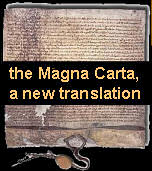
The 1215 Magna Carta (an English translation) [1]
Surety barons for the enforcement of the Magna Carta [1215]
Associated documents
Colour key
End notes
John, by the grace of God, king of England, lord of Ireland, duke of Normandy and Aquitaine, and count
of Anjou, to the archbishops, bishops, abbots, earls, barons, justiciars,
foresters, sheriffs,
stewards, servants, and to all his bailiffs and faithful subjects, greeting.
Know that, having regard to God and for the salvation of our soul, and those
of all our ancestors and heirs, and unto the honour of God and the advancement
of the holy Church, and for the reform of our realm, by advice of our venerable
fathers, Stephen archbishop of Canterbury, primate of all England and cardinal
of the holy Roman church, Henry archbishop of Dublin, William of London, Peter
of Winchester, Jocelyn of Bath and Glastonbury, Hugh of Lincoln, Walter of
Worcester, William of Coventry, Benedict of Rochester, bishops; of master
Pandulf, subdeacon and member of the household of our lord the Pope, of brother
Aymeric (master of the Knights of the Temple in England), and of the illustrious
men William Marshall earl of Pembroke, William earl of Salisbury, William
earl of Warenne, William earl of Arundel, Alan of Galloway (constable of Scotland),
Waren Fitz Gerald, Peter Fits Herbert, Hubert de Burgh (seneschal of Poitou),
Hugh de Neville, Matthew Fitz Herbert, Thomas Basset, Alan Basset, Philip
d’Aubigny, Robert of Roppesley, John Marshall, John Fitz Hugh, and of
other faithful subjects.
- In the first place we have
conceded to God, and by this our present charter confirmed for us and our
heirs for ever that the English church shall be free,
and shall have her rights entire, and her liberties inviolate; and we wish
that it be thus observed. This is apparent from the fact that we, of our
pure and unconstrained will, did grant the freedom of elections, which is
reckoned most important and very essential to the English church, and did
by our charter confirm and did obtain the ratification of the same from
our lord, Pope Innocent III., before the quarrel arose between us and our
barons. This freedom we will observe, and our will is that it be observed
in good faith by our heirs for ever.
We have also granted to all freemen of our kingdom, for us and our heirs for ever, all the underwritten liberties,
to be had and held by them and their heirs, of us and our heirs for ever.
- If any of our earls or barons, or others holding
of us in chief by military service shall have died, and at the time of his death his heir
shall be of full age and owe relief he shall have his inheritance on payment of the ancient relief, namely the
heir or heirs of an earl, 100 pounds for a whole earl’s barony; the
heir or heirs of a baron, 100 pounds for a whole barony; the heir or heirs
of a knight, 100
shillings at most for a whole knight’s fee; and whoever owes less let him give less,
according to the ancient custom of fiefs.
- If, however, the heir of any of the aforesaid has
been under age and in wardship, let him have his inheritance without relief
and without fine when he comes of age.
- The guardian of the land of an heir who is thus
under age, shall take from the land of the heir nothing but reasonable produce,
reasonable customs, and reasonable services, and that without destruction
or waste of men or goods; and if we have committed the wardship of the lands
of any such minor to the sheriff, or to any other who is responsible to
us for its issues, and he has made destruction or waste of what he holds
in wardship, we will take of him amends, and the land shall be committed
to two lawful and discreet men of that fief, who shall be responsible for the issues to us or to him to whom we shall
assign them; and if we have given or sold the wardship of any such land
to anyone and he has therein made destruction or waste, he shall lose that
wardship, and it shall be transferred to two lawful and discreet men of
that fief, who shall be responsible to us in like manner as aforesaid.
- The guardian moreover, so long as he has the wardship
of the land, shall maintain the houses, parks, fish ponds, stanks,
mills, and other things pertaining to the land, out of the revenues of that
land; and he shall restore to the heir, when he has come to full age, all
his land, stocked with ploughs and waynage,
according as the season of husbandry requires, and the revenues from the land can reasonably support.
- Heirs shall be married without disparagement.
However, before a marriage takes place, it shall be made known to the heir’s next-of-kin.
- A widow, after the death of her husband, shall
forthwith and without difficulty have her marriage portion and inheritance.
She shall not give anything for her dower, or for her marriage portion,
or for the inheritance which her husband and she held on the day of the
death of that husband. She may remain in the house of her husband for forty
days after his death, within which time her dower shall be assigned to her.
- No widow shall be compelled to marry, so long as
she prefers to remain without a husband, always provided that she gives
assurance not to marry without our consent, if she holds her lands from
us, or else without the consent of whatever other lord she from whom she
holds her lands.
- Neither we nor our bailiffs shall seize for any
debt any land or rent, so long as the chattels of the debtor are sufficient to repay the debt. Nor shall those that pledged
sureties for the debtor be distrained so long as the principal debtor himself is able to satisfy the debt. If the principal debtor fails to pay the debt, having nothing wherewith to
pay it, then the sureties shall answer for the debt. They shall have the lands and rents of the debtor,
if they desire them, until they are reimbursed for the debt which they have
paid for him, unless the principal debtor can show proof that he has discharged
his obligations to them.
- If one who has borrowed
from the Jews any sum, great or small, dies before that loan can be repaid,
his heir shall pay no interest on the debt for so long as he remains under age, irrespective from whom he holds his lands.
If such a debt falls into our hands, we will take nothing except the principal sum mentioned in the bond.
- And if any one die indebted to the Jews, his wife shall have her dower and pay nothing of that debt;
and if any children of the deceased are left underage, necessaries shall be provided for them in keeping with the holding of the deceased. The debt
shall be paid out of the residue, save the service due to feudal lords. Let debts due to others than Jews be dealt with in similar manner.
- No scutage nor aid shall be imposed on our kingdom, unless by common counsel of our kingdom,
except for ransoming our person, for making our eldest son a knight, and
marrying our eldest daughter one time. For these, only a reasonable aid
should be levied. In like manner it shall be done concerning aids from the
city of London.
- And the city of London shall
have all its ancient liberties and free customs, by land as well as by water.
Furthermore, we decree and grant that all other cities, boroughs, towns,
and ports shall have all their liberties and free customs.
- And for obtaining the common
consent of the kingdom concerning the assessment of an aid (other than in
the three cases specified above) or of a scutage,
we will cause to be summoned the archbishops, bishops, abbots, earls, and
greater barons, individually through our letters. Moreover, all others who
are our direct tenants, we will cause a general summons to be made by our
sheriffs and bailiffs, for a fixed date (namely, after the expiry of at
least forty days) and at a fixed place. In all such letters of summons we
will specify the reason of the summons. And when the summons has thus been
made, the business shall proceed on the day appointed, according to the
counsel of such as are present, although not all who were summoned have
come.
- In future, we not grant
to anyone license to take an aid from his own free men, unless to ransom
his person, to make his eldest son a knight, and once to marry his eldest
daughter. And on each of these occasions, only a reasonable aid shall be
levied.
- No man shall be compelled to do more service for
a knight’s fee, or for any other land free-holding, than is due from
it.
- Common pleas shall not follow our court about, but shall be held in some fixed place.
- Inquests of novel disseisin, mort d’ancestor,
and darrein presentiment shall only be held in their own county courts, in the following
manner. We or, should we be out of the kingdom, our chief justice will send two justices to each county four times a year who, along with four knights
of each county chosen by that county, shall hold the assize in the county, and on the day and in the meeting place of the county court.
- If any of the said assizes cannot be held on the
day of the county court, let there remain as many of the knights and freeholders,
who were present at the county court on that day, as are necessary for the
efficient making of judgments, according to whether the business is more
or less.
- A freeman shall only be amerced for a trivial offence in accordance with the seriousness of the offence.
For a grave offence, he shall be fined correspondingly, leaving him his contenement.
A merchant will be fined similarly, leaving him his “merchandise”;
and a villein shall be amerced in
the same way, leaving him his wainage—if
they have fallen into our mercy. These amercements shall only be imposed by the assessment on oath of reputable local men.
- Earls and barons shall be amerced only by their peers,
and only in proportion with the degree of the offence.
- A clerk in holy orders shall not be amerced in respect of his lay holding except as previously described; further, his ecclesiastical benefice shall not be
taken into account.
- No vill or person shall be compelled to make bridges at river-banks, except those who from of old were legally bound to do so.
- No sheriff, constable, coroner, or other royal bailiff, shall hold lawsuits meant be held by the royal justices.
- All counties, hundreds, wapentakes, and trithings shall remain at old rents, and without any
increase, except our demesne manors.
- If any one holding
a lay fief from the Crown dies, and our sheriff or bailiff produces
royal letters patent of summons for a debt owed to the Crown, it shall be lawful for
our sheriff or bailiff to seize and catalogue chattels found in the lay
fief of the deceased, to the value of that debt, as assessed by law-worthy men. Nothing at all shall be removed from there until the debt is fully
paid. The residue shall be left to the executors to fulfil the will of the
deceased. If there is no debt due to the Crown, all the chattels shall go
to the estate of the deceased, except reasonable shares for his wife and
children.
- If any freeman dies intestate,
his chattels shall be distributed by his nearest kinsfolk and his friends,
under supervision of the church, except that the rights of his debtors shall
be maintained.
- No constable or other royal bailiff shall take
corn or other provisions from any man without an immediate cash payment,
unless the seller permits postponement of this.
- No constable shall compel any knight to give
money instead of castle-guard,
if the knight is willing to undertake the guard himself, or to supply another
responsible man to do it, if he cannot do it himself for any reasonable
cause. Further, a knight taken or sent on military service shall be excused
castle-guard in proportion to the time he was on this service.
- No sheriff or royal bailiff, or other person,
shall take the horses or carts of any freeman for transport duty, except
with agreement from the said freeman.

|
advertising
disclaimer |